Is your electric car the home battery of the future?
Your electric car may do much more than take you from A to B in the future.
With bidirectional charging, an electric car can not only take in electricity, but also feed it back. This creates a new way to use energy: your car can store sustainable electricity during the day and make that energy available to your home at a later time.
Your electric car can thus become a mobile home battery.
At Novectra, we see bidirectional charging as one of the technologies that can fundamentally change the way we generate, store and use electricity.
From charging to sharing energy
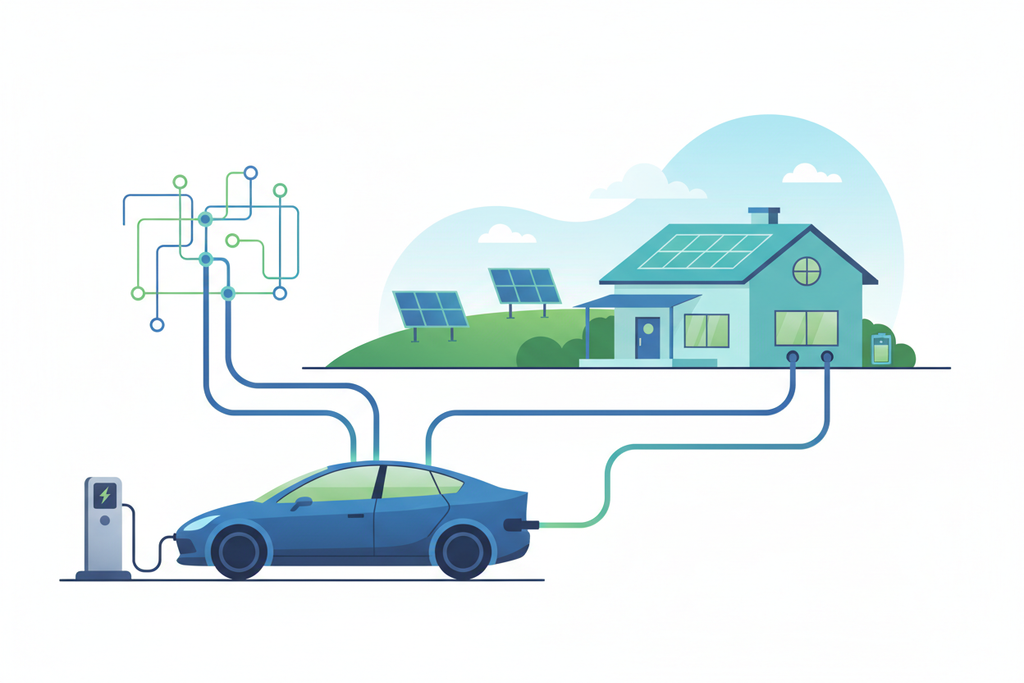
From charging to sharing energy Net → EV
Electricity flows from the electricity grid to the battery of your electric car.
With bidirectional charging, the energy flow can go both ways: Net ↔ EV
The battery of your electric car can thus become part of a larger energy system, together with, for example, solar panels, a home battery and an Energy Management System (EMS).
That offers interesting possibilities for the way we generate, store and use energy.
What is V2H?
One of the most interesting applications of bidirectional charging is Vehicle-to-Home (V2H).
With V2H, a suitable electric car can supply electricity to your home.
Suppose your solar panels generate more electricity during the day than your household consumes at that moment. Instead of feeding all this surplus energy back into the electricity grid, you can store part of it in the battery of your electric car.
When your solar panels produce little or no electricity in the evening, your home can then use the energy stored in the car.
The principle is simple: Solar panels → EV battery → Home
Your electric car thus becomes an additional form of energy storage.
This can become increasingly interesting for households that want to use as much of their self-generated solar energy as possible themselves.
And what is V2G?
The next step is Vehicle-to-Grid (V2G).
With V2G, an electric car can not only supply electricity to your home, but in principle also feed it back into the public electricity grid.
This gives the electric car a very different role.
The EV is then not only a consumer of electricity, but can also function as a flexible part of the energy system.
For example, a car can charge when a lot of electricity is available or when the electricity price is low. At other times, stored energy can be fed back.
When thousands or even millions of electric cars are deployed in this way, the impact on the electricity system can be considerable.
The combined batteries of electric cars can thus grow into a large, decentralised network for energy storage.
Your EV as part of a smart energy system
Is bidirectional charging already possible?
Yes, but there is an important caveat.
Not every electric car supports bidirectional charging.
Also, not every charging station is suitable for feeding electricity back from the car.
For a properly functioning V2H or V2G system, various components must be able to work together.
1. The electric car
The car must support the required functionality for bidirectional charging. Some electric cars have Vehicle-to-Load (V2L), which allows the car to supply power to external devices. A smaller, but growing number of models also support Vehicle-to-Home (V2H) or Vehicle-to-Grid (V2G).
Examples of electric cars with bidirectional charging capabilities include:
- Hyundai IONIQ 5
- Hyundai IONIQ 6
- Kia EV6
- Kia EV9
- Ford F-150 Lightning
- Renault 5 E-Tech electric
- Renault 4 E-Tech electric
*Availability of V2H or V2G depends on factors including the car’s specification, software, charging equipment, energy supplier and the local market.

2. The charging station
A standard charging station is primarily designed to charge your electric car. For bidirectional charging, suitable charging equipment is needed that can manage the energy flow in both directions.
Novectra helps you select and install a suitable charging solution. We look not only at the charging station itself, but also at your electric car, solar panels, electrical installation and any battery storage.
3. Communication and energy management
The electric car, charging station and energy management system must be able to communicate with each other in the right way.
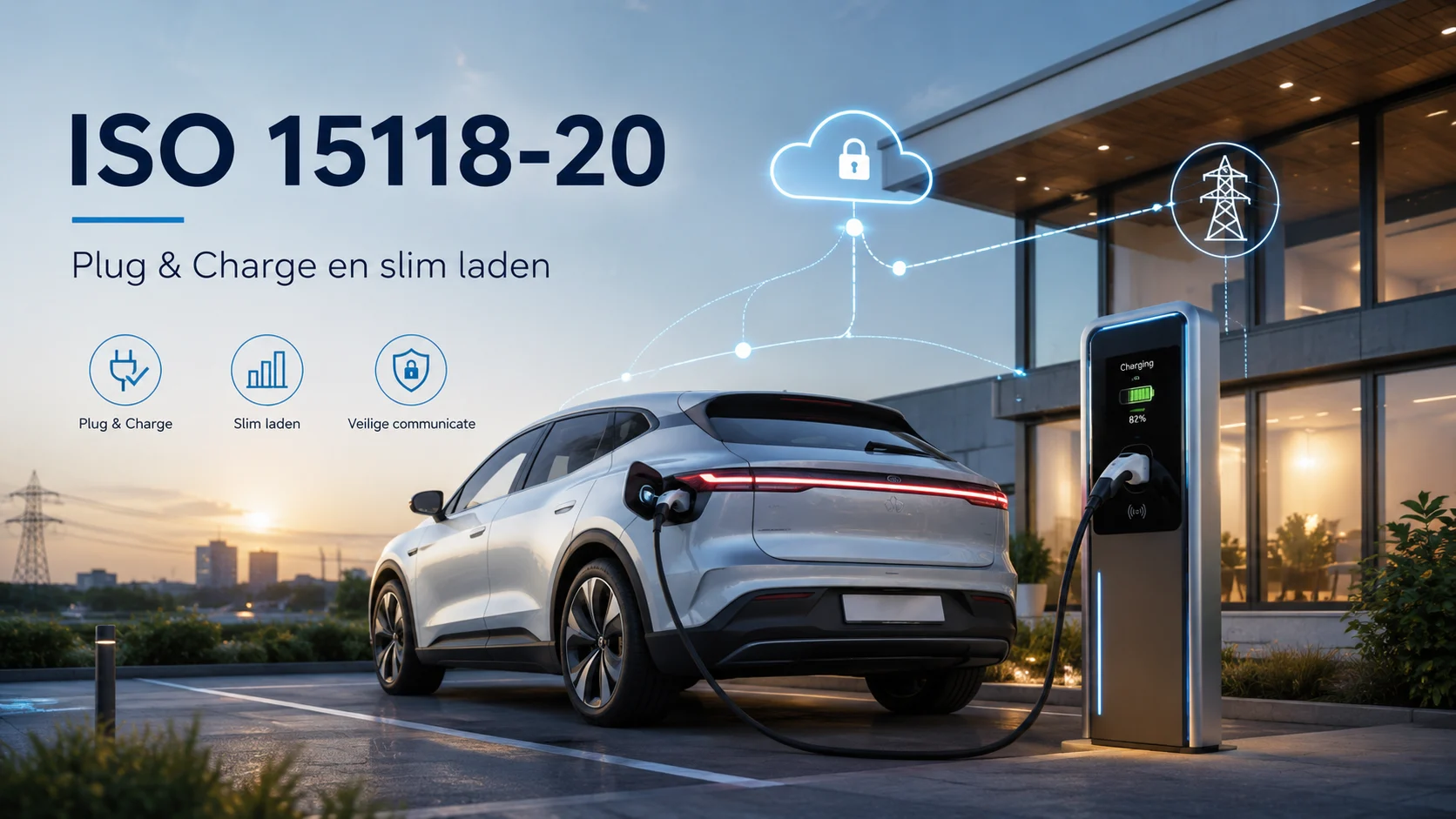
Standards such as ISO 15118-20 play an important role here. This standard describes, among other things, the communication between electric vehicles and charging equipment for bidirectional energy flows.
Good interoperability between cars, charging stations and energy systems is essential for the further development and large-scale application of V2H and V2G.
Bidirectional charging with Novectra
Novectra supplies and installs EV charging solutions for homes and businesses, with a focus on smart and integrated energy systems.
Whether you need a charging station today or want to prepare your installation for tomorrow’s technology: we are happy to advise you. We can assess your electric car, electrical installation and existing energy system and explore how solar panels, battery storage, a charging station and energy management can work together.
Contact Novectra for more information. We would be happy to discuss your requirements and explore the options together.